20Jan

Teacher Spotlight: How an International Educator is Making an Impact in Adams County 

In the world of education, the most profound impacts often happen when cultures collide and knowledge is shared across borders. Today, we are spotlighting Prosper Opoku Agyemang, a dedicated Special Education teacher currently teaching grades 9–12 in the Adams County 14 Schools District, Colorado. 

Originally from Ghana, Prosper brought eight years of teaching experience with him when he decided to join the Teacher Exchange Program. His journey is a testament to the power of cultural exchange and the universal language of education. 

A Strong Foundation in Inclusion 

Prosper holds a Bachelor’s degree in special education from the University of Education, Winneba in Ghana. His academic background provided a robust foundation in individualized instruction and behavior management, which he now applies to his U.S. classroom. 

When asked what motivated him to teach in the U.S., Prosper noted a desire to broaden his professional experience in a multicultural environment. “I wanted to bring new learning opportunities and perspectives to my students while continuing to advocate for inclusion and equity in education,” he explains. 

The Cultural Exchange: Jollof Rice and Student Voice 

One of the unique benefits of international teachers is the rich cultural exchange that occurs within the school. Prosper has actively shared Ghanaian traditions with his students, introducing them to the concept of community and “togetherness” that is central to his culture. He has also shared tangible pieces of home, such as kente cloth, traditional music, and foods like jollof rice. 

In return, the U.S. education system has offered Prosper new perspectives. He has discovered the importance of “student voice” in American classrooms, where students are encouraged to think critically and share their opinions—a dynamic he values greatly.  

Overcoming Challenges to Find Success 

Prosper admits that adapting to the structure and new instructional technologies was challenging at first. However, navigating these differences has made him a stronger, more adaptable educator. 

The rewards, he says, outweigh the challenges. Prosper describes his most rewarding experience as seeing students grow in confidence and independence. He recalls a specific breakthrough with a student who had difficulty communicating; after weeks of consistent support, the student began expressing himself openly. 

“Knowing that I am making a positive impact in their lives while sharing my culture and learning from theirs has made this journey deeply meaningful,” Prosper reflects. 

Impact on the School Community 

Since arriving, Prosper has received positive feedback from families and administrators for his patience and dedication. He utilizes collaborative learning activities and storytelling—methods emphasized in Ghanaian classrooms to make abstract concepts relatable for his students. These strategies have been so effective that colleagues have expressed interest in adopting them, fostering a spirit of collaboration within the school. 

Looking Ahead 

Prosper believes that having international teachers helps students develop global awareness, which is essential in today’s interconnected world. His goal for the coming years is to continue enhancing his skills in special education technologies while taking on leadership roles to support his colleagues. 

To his community back home, Prosper sends a message of encouragement: “I encourage my community to embrace opportunities that allow them to learn, share, and make a positive impact, no matter where in the world they are”. 

If you are a passionate educator ready to share your culture, challenge yourself professionally, and inspire a new classroom of students, we invite you to follow in Prosper’s footsteps. 

Are you ready to bring your unique perspective to a U.S. school district? Apply with International Alliance Group (IAG) Today!
 

13Jan

The “Classroom Bayanihan” Model: Teaching Collaboration Through Culture 

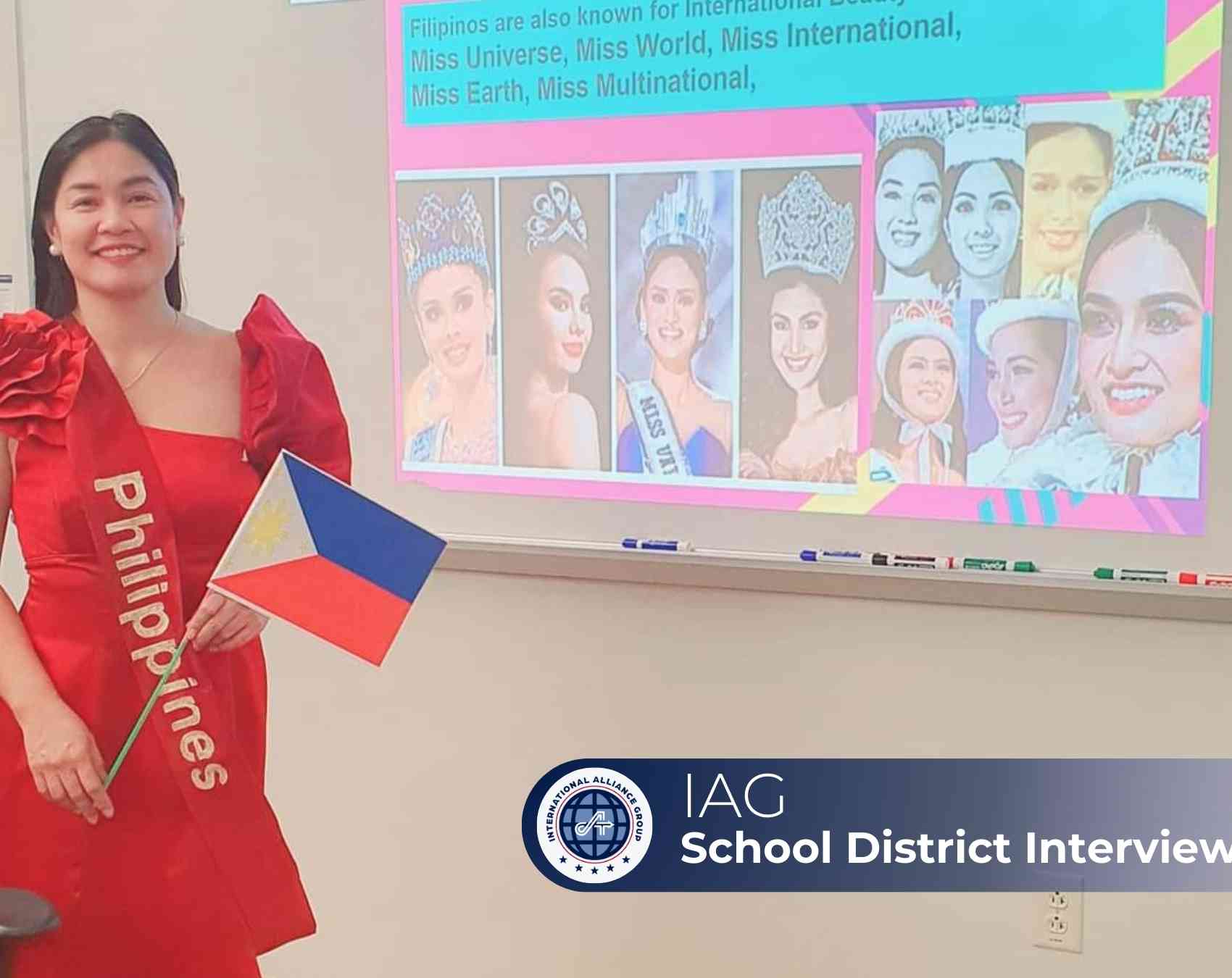
When Jeanie Mae Hernal arrived in Colorado from the Philippines, she brought more than just her expertise in Chemical Engineering and a Master’s in Education. She brought a powerful cultural concept that would transform her classroom at Adams 14 School District: Bayanihan. 

With 8 years of experience in her home country, Jeanie is now teaching Physics and Astronomy to high schoolers in the U.S. Her journey is a testament to how international teachers do far more than fill a vacancy—they create a “living curriculum” that bridges cultures and ignites student potential. 

The “Classroom Bayanihan” Model 

In the Philippines, Bayanihan represents community unity—an “all-for-one, one-for-all” spirit where neighbors come together to achieve a common goal. Jeanie noticed that her U.S. students were initially very individualistic and hesitant to share ideas for fear of being wrong. 

To bridge this gap, she introduced the “Classroom Bayanihan” model. Instead of simple group work, she assigns complex tasks where every student has a critical role, such as a “Leader” or “Time-keeper”. The result? A dynamic transformation. 

“The room is now filled with this productive, noisy energy of them debating solutions, drawing diagrams on whiteboards, and teaching each other,” Jeanie explains. 

Her students have moved from being disengaged to becoming resilient teammates who are no longer afraid of making mistakes. 

Physics in the Real World 

Jeanie didn’t just change how her students worked; she changed what they worked on. Facing the challenge of adapting to a new school culture, she designed lessons that were alive and dynamic. 

By integrating sports scenario analysis, gamified lessons, and fun projects, she saw students who were previously written off as “disengaged” suddenly light up. Seeing them take pride in their work made Jeanie feel that she truly belonged as an educator in the U.S.. 

A Cultural Ambassador 

Beyond the laws of physics, Jeanie teaches the value of global connection. She openly shares her Filipino heritage, from values like pag-aaruga (nurturing) and pakikisama (getting along) to bringing traditional foods like lumpia and pancit to staff meetings. 

This openness has sparked a “global curiosity” in her students. They now ask questions like, “How do they solve this problem in other countries?” proving that they are making connections beyond their own town. 

Unstoppable Passion 

Jeanie’s impact hasn’t gone unnoticed. She has been recognized as a “Pioneer Teacher” in the ACED Academy and was a presenter at the National Science Teacher Conference in Denver. Her colleagues and administrators describe her as “Unstoppable,” “Passionate,” and an “Inspiration”. For Jeanie, the experience has been about growth. 

“I realized that I could do more. I could adapt my teaching style, bridge that cultural gap, and connect with my American students in a way that was meaningful for them,” she says. 

Ready to Make Your Impact? Jeanie Mae Hernal is proving that science and culture go hand-in-hand. If you are an experienced educator ready to bring your own unique perspective to a U.S. classroom, IAG is ready to help you start your journey. 


12Jan

How to Ace Your U.S. School District Interview 

Landing a teaching position in the United States is a dream for many educators, but the interview process can feel different from what you might be used to in your home country.  

U.S. Districts aren’t just looking for someone who knows the subject matter- they are looking for a specific type of educator who can thrive in a dynamic, diverse American classroom. 

At IAG, we are committed to your success. That is why we provide you with our exclusive Teacher Interview Guide to help you navigate every step of the process. Drawing from this essential resource, here is a breakdown of exactly what U.S. school districts are looking for and how you can prepare to impress them 

1. Master the “Big 5” Qualities 

When a district interviewer speaks with you, they are silently scoring you on five specific qualities. To succeed, your answers should demonstrate these traits: 

      • Instructional Competence: Qualified candidates demonstrate strong content knowledge and how to align it with state standards. You must be able to differentiate instruction to meet the needs of diverse learners, including those with language or cultural differences. 

        • Classroom Management: The teacher must be able to build positive relationships, set and teach behavior expectations, establish clear routines, and manage behavior proactively by reinforcing expectations (i.e.: Be Respectful, Responsible, Safe) and using consistent accountability when students are not respectful, not responsible, and not safe. 

          • Reflective & Growth-Oriented: U.S. schools love “lifelong learners.” Be ready to discuss how you use feedback to improve and how you use student data to adapt your teaching. 

            • Collaborative: Strong candidates are team players who contribute to a positive school culture by collaborating with colleagues, supporting school initiatives, and communicating effectively with families. 

              • Student-Centered Mindset: The best teachers consistently prioritize student learning, well-being, and inclusion. They believe all students can succeed and are committed to equity and cultural responsiveness. 

            2. Key Topics & Questions to Expect 

            U.S. interviews go far beyond your biography; they are structured to test your specific teaching methodology in real time. You should be prepared to discuss Instruction and Engagement in depth. Interviewers often ask, “How do you structure a lesson to keep students engaged?” or request that you explain your specific teaching methods. They are looking for evidence that you move beyond simple lecturing; a great response describes how you “incorporate videos, hands-on activities, and discussions” to reach different learning preferences, ensuring students are active participants rather than passive listeners. 

            You will also face scenario-¿ based questions regarding Classroom Management. Instead of asking generally about rules, they may ask, “How do you handle discipline issues?” or “What strategies do you use with unmotivated students?”. The key here is to demonstrate a proactive approach. Successful candidates explain how they “co-create classroom expectations with students” to promote shared ownership and use “specific praise” to reinforce positive behavior, rather than focusing solely on punishment. 

            Furthermore, U.S. districts require proof that students are learning, which leads to questions about Assessment and Data. Be ready to answer, “How do you use data to inform instruction?”. It is not enough to mention final grades; you should explain how you use formative assessments like “exit tickets and quick writes” to check understanding during the lesson. This allows you to explain how you “adjust pacing and reteach specific concepts” immediately if the data shows students are struggling. 

            Finally, because American classrooms are incredibly diverse, you must address Differentiation. You will almost certainly be asked, “How do you support English Language Learners (ELLs)?” or students with special needs. A strong answer avoids vague promises and instead offers concrete examples of scaffolding, such as providing “sentence starters, graphic organizers, or visuals” to ensure that every student, regardless of their language level or ability, can access the curriculum. 

            3. The Virtual Interview Checklist 

            Most international interviews happen via Zoom. Don’t let technical issues hide your talent. Follow this checklist from our HR guide: 

                • Lighting & Background: Sit facing a window. Never sit with your back to a window, or you will look like a shadow. Choose a clean, uncluttered wall, or use a neutral virtual background. 

                  • Eye Contact: This is a big cultural difference. 

                    • Camera & Audio: Position camera at eye level, not angled up toward your face (use books or a stand if needed), center yourself in the frame – head and shoulders should be visible, use headphones or a microphone for clear audio. 

                      • Appearance & Presence:  Dress professionally (as you would for an in person interview), sit up straight and look directly into the camera lens, not at the face on the screen. This simulates eye contact and shows confidence. 

                    4. Turn the Tables: Ask Questions! 

                    At the end of the interview, they will ask, “Do you have any questions for us?”. Never say no. Asking questions shows you are a professional who cares about the school culture. Here are three great questions to ask: 

                      1. “What types of professional development do teachers have access to?”  
                      2. “How does the school engage with families and the broader community?” 
                      3. “Does the school implement PBIS or Restorative Practices?”  

                        Final Tip: Be Yourself 

                        While the Teacher Interview Guide is a powerful tool, remember that your greatest asset is your authenticity. The goal of the interview is to demonstrate your professional judgment and personal teaching style. Focus on internalizing the concepts—like student engagement and classroom management—and then explain them in your own voice. Show the interviewers that you are a confident professional ready to contribute to their community from day one.

                        06Jan

                        Learning Through Lyrics: How Songs Are Building Confidence in Young Learners

                        Moving across the world to teach is a bold step, but for Azenith Torda, it was a necessary one to grow as a professional and build global understanding. With 14 years of teaching experience in the Philippines and a Master’s in Arts of Education, Azenith brought a wealth of knowledge to her new role as a Kindergarten teacher at Columbia Public Schools in Missouri. 

                        Bridging Cultures Through Song and Story 

                        One of the most powerful tools Azenith brought from the Philippines is her approach to engagement. In her home country, education relies heavily on stories, songs, and group activities. She has seamlessly integrated these methods into her U.S. classroom to help children listen, speak, and understand new concepts. 

                        The results have been heartwarming. Azenith recalls one of her most rewarding experiences: teaching her students traditional Filipino songs. “Seeing their faces light up as they learned the lyrics and sang proudly was truly unforgettable,” she shares. 

                        By sharing her traditions—including holidays, foods, and storytelling—she has created a richer, more inclusive classroom where young students learn to appreciate different cultures early on. 

                        Growth and Confidence in the Classroom 

                        Since arriving in Missouri, Azenith has noticed a significant transformation in her students. She notes that they have become “more confident, ask questions without hesitation, and share their ideas openly.”  

                        The impact is felt beyond the students. Azenith received touching feedback from her principal, who noted that the families “love her,” and it is evident that the students return that love. 

                        A Message on Cultural Exchange

                        Azenith believes that international teachers bring new ideas that help students learn about the world. Her message to district leaders is clear: “Cultural exchange helps students and teachers learn from different perspectives, appreciate diversity, and make the school a more creative and welcoming place.”  

                        As she continues her journey, Azenith plans to keep growing as a teacher, learning new strategies to bring back to her community in the Philippines, and continuing to inspire her students in Missouri. 

                        Ready to Write Your Own Story? Azenith’s journey from the Philippines to Missouri started with a desire to grow and share her culture. If you are an experienced educator ready to bring your own excellence and culture to a U.S. classroom, we want to hear from you. 

                        05Jan

                        Required Documents for the J-1 Program: Complete 2026 Checklist

                        Teaching in the United States through the J-1 Teacher Cultural Exchange Program is a professional and cultural opportunity.
                        Before reviewing documents, it’s important to confirm that you meet the basic program requirements.

                        Step 1: J-1 Teacher Program Requirements

                        You may qualify for the J-1 Teacher Program if you:

                        • Hold a Bachelor’s degree or higher in Education or a related teaching field
                        • Completed formal teacher preparation, including supervised teaching practice
                        • Have at least two years of full-time teaching experience
                        • Are currently teaching or have taught within the last academic year
                        • Can demonstrate advanced English proficiency
                        • Are eligible to participate in a cultural exchange program

                        If you meet these requirements, the next step is understanding the documents required for the program.

                        Step 2: Required Documents (Explained)

                        Below is the complete list of documents required for the J-1 Teacher Program, with a brief explanation of each one.

                        1. Resume / CV and Cover Letter
                        Your resume introduces your professional background to U.S. schools. It must:
                        • Be written in English
                        • Be updated to the current academic year
                        • Include education, teaching experience, subjects, grade levels, certifications, and languages
                        2. Valid Passport
                        Your passport confirms your identity and eligibility for international travel.
                        • Must be valid for at least 3 years, or the maximum allowed by your country
                        • Be updated to the current academic year
                        • The biographical page must clearly show your photo and personal information
                        3. Foreign Credential Evaluation (FCE)
                        The Foreign Credential Evaluation provides a U.S. equivalency of your academic studies and is required for all international degrees. It must:
                        • Be issued by a NACES-member evaluation agency
                        • Include a course-by-course analysis
                        • Evaluate all college-level coursework
                        • Show teacher preparation and K–12 teaching practice
                        • Be valid for 5 years
                        4. Letter Verifying Full-Time Teaching Employment
                        This letter confirms your current professional status as a teacher.
                        • Confirms current full-time classroom teaching
                        • Is issued by your school
                        • Is written on official letterhead
                        • Is signed and dated during the current academic year
                        • Be valid for 5 years

                        This is not a recommendation letter.

                        5. Professional License or Letter of Good Standing (If Applicable)
                        This document verifies your eligibility to teach in your home country.
                        • If your country issues a teaching license or professional credential, it is required
                          (Example: Cédula Profesional in Mexico)
                        • If your country does not issue a teaching license, a Letter of Good Standing from an education authority may be used instead
                        6. Approved English Proficiency Assessment
                        You must demonstrate English proficiency through an approved exam taken within the last two years. Accepted exams include:
                        7. Letters of Reference
                        Two professional references are required:
                        • One from a supervisor
                        • One from a colleague

                        They must address:

                        • Teaching ability
                        • Professional character
                        • Be dated during the current academic year
                        8. One-Way Interview
                        Applicants complete a structured video interview that evaluates:
                        • Professional knowledge
                        • Teaching philosophy
                        • English communication skills
                        9. Teaching Demonstration Video
                        This video allows schools to see you as an educator.
                        • Conducted in English
                        • Demonstrates subject knowledge, instructional strategies, and classroom presence
                        • Does not require a live classroom setting
                        Important: You Don’t Need All Documents to Get Started

                        Good news—you do not need to have all documents ready to begin your J-1 Teacher application.

                        At the initial registration stage, the focus is on:

                        • Confirming that you meet the teacher profile
                        • Demonstrating your English proficiency

                        Once you register, a recruiter will review your profile and contact you directly to guide you through the next steps and request the remaining documents when needed.

                        What Matters Right Now

                        If you’re just getting started, this is what’s important:

                        • Have your Bachelor’s degree information available
                        • Confirm that your education includes teacher preparation
                        • Take an approved English test to verify that you meet at least a B2 level

                        You can take the EFSET 90-minute English test for free to confirm your level before moving forward.

                        👉EFSET EXAM HERE

                        If today you don’t have every document listed above, don’t worry. The most important step right now is to register, confirm that you qualify, and start the conversation.

                        Ready to Get Started?

                        If you meet the profile and are ready to verify your English level, you can begin your registration today.

                        23Dec

                        A Doctorate in the Kindergarten Classroom: The Story of Dr. Nubia Salazar 

                        Early childhood education is where curiosity, confidence, and a love of learning begin to take shape. In Richland One, South Carolina, a group of kindergarten students is experiencing this important stage alongside an educator whose expertise, warmth, and cultural perspective enrich the classroom every day.

                        We are honored to spotlight Dr. Nubia Elena Salazar Ramos, a highly accomplished educator from Mexico who is bringing cultural immersion, meaningful connection, and innovative teaching practices into early childhood education.

                        A Distinguished Career 

                        Nubia is not just a teacher; she is a master of her craft. Before arriving in the U.S., she dedicated 25 years to education in her home country of Mexico. Her academic credentials are equally impressive: she holds a Doctorate from the Escuela Normal Superior de Ciudad Madero Tamaulipas and notes that she has completed five different career paths/degrees to support her practice. 

                        Driven by a desire to grow professionally and experience a multicultural environment , Nubia brought this wealth of knowledge to South Carolina. 

                        The Challenge of Immersion 

                        Teaching kindergarten is a challenge in itself, but Nubia takes it a step further. She is a Spanish immersion teacher, meaning she teaches subjects like Science and Mathematics entirely in a second language. 

                        Her goal is to ensure students don’t just memorize words, but actually learn to express themselves and understand complex concepts in Spanish. To achieve this, she uses an immersive approach: even when students don’t understand initially, she prioritizes Spanish instruction to meet the learning objective. 

                        The results are already showing. Her students are successfully learning numbers and are beginning to understand instructions and vocabulary in Spanish. 

                        Blending Methodologies 

                        Nubia’s classroom is a blend of structure and exploration. She utilizes TPR (Total Physical Response) activities, a method that connects language with physical movement, which is essential for young learners. 

                        However, she also brings sophisticated pedagogical strategies from Mexico. She focuses on autonomous learning and “questioning,” helping students build upon their prior knowledge. She believes this approach is essential for creating “meaningful and lifelong learning”. By implementing order and discipline exercises similar to those used in Mexico, she balances classroom management with student independence. 

                        Celebrating Culture  

                        Beyond the academics, Nubia ensures that culture is at the heart of her classroom. She recently organized a parade to share the traditions of Mexico and Colombia with her school community. 

                        For Nubia, the exchange is mutual. She enjoys the diversity of the U.S. school system, noting how valuable it has been to witness presentations from other Latin American teachers and learn about their unique cultures. 

                        A Goal of Excellence  

                        Nubia’s journey is defined by a constant drive for improvement. She recognizes the vast resources and materials available in her U.S. district and plans to use them to enrich her students’ knowledge. Her personal goal for the coming years is simple but ambitious: to develop new skills and become “one of the best teachers”. 

                        Dr. Nubia Salazar is proof that the J-1 program brings world-class talent to U.S. schools, enriching the lives of students through experience, culture, and academic excellence. 


                        22Dec

                        How to Validate Your Teaching Degree in the USA

                        You have your “Licenciatura en Educación” from Peru, or your “Título de Maestro” from México. You know you are qualified, but how does a school district in the United States know that? 

                        The answer is a “Credential Evaluation.” This is one of the most critical steps in the J-1 Teacher Program, and IAG is here to break it down for you. 
                         
                        1.  

                        What is a Credential Evaluation?

                        It is an official report created by a specialized agency in the U.S. This report analyzes your foreign university education (your transcripts and your diploma) and “translates” it into its American academic equivalent. 

                        For example, the report will officially certify that your “Licenciatura en Educación Primaria” is the academic equivalent of a “U.S. Bachelor’s Degree in Elementary Education.” 


                        Why is This Evaluation Necessary?  

                        This report is mandatory for three fundamental reasons: 

                        • J-1 Visa Program: The U.S. Department of State requires this report to prove that you meet the educational requirements to participate as an exchange visitor. 
                        • School Placement: U.S. schools cannot accept your participation without it. They need this report to verify that you are qualified to teach your specific subject area as part of the program. 
                        • Stipend Determination: The report (specifically a “Course-by Course” evaluation) is used by the school district to determine your stipend level, ensuring you receive fair compensation based on your education level. 
                         

                        How to Obtain Your Credential Evaluation  

                        You cannot perform this evaluation yourself. You must use a company that is a member of NACES (National Association of Credential Evaluation Services). 

                        At IAG, we guide our candidates through the entire process: 

                        • Choose the Right Report: This is crucial. You will almost always need a “Course-by Course” or “Detailed” evaluation, not just a “Document-by-Document” one. The school district needs to see every subject you completed. 
                        • Gather Your Documents: You will need your official academic transcripts (the list of all subjects and grades) and your diploma (proof of graduation). 
                        • Follow the Agency’s Process: Each agency has specific rules regarding how documents must be submitted. 
                        • Wait for the Report: The process can take several weeks, so it is important to follow your IAG advisor’s guidance on whe to start.

                        Connecting Your Talent with U.S. Classrooms  

                        We understand that this process can seem challenging, but you don’t have to navigate it alone. As an International Alliance Group (IAG) candidate, our team is here to guide you step-by-step and advise you on: 

                        • Which agency to use. 
                        • Which specific report to order. 
                        • When to start the process so it doesn’t delay your application. 

                        This evaluation is the key that unlocks the door to your career in the U.S. 

                        Have questions about your degree or the J-1 process? Explore the J-1 Visa requirements at the link.

                        •  
                         
                        16Dec

                        Songs, Stories, and Success: Krizel Abat’s Classroom Transformation  

                        True professional growth often requires stepping into the unknown. For educators in the J-1 cultural exchange program, this means leaving behind the familiar to embrace a completely new environment, educational system, and community. 

                        This courage to step out of one’s comfort zone defines Krizel Abat, an experienced educator from the Philippines who is currently transforming her 1st-grade classroom in Vallejo, California.  

                        A Wealth of Experience

                        Before arriving in the U.S., Krizel had already established herself as a dedicated leader in education. With nine years of teaching experience in her home country, she holds not only a Bachelor of Elementary Education but also a Master of Arts in Educational Management.  

                        She joined the exchange program with a clear mission: to challenge herself, experience a multicultural classroom, and bring new opportunities to her students while sharing the richness of her own culture.

                        Bringing Rhythm to the Classroom 

                        One of the most beautiful aspects of cultural exchange is seeing how different teaching traditions can blend to create something new. 

                        In her U.S. classroom, Krizel realized that her students needed more than just standard instruction they needed engagement. Drawing on her roots in the Philippines, she introduced songs, chants, and traditional storytelling into her daily lessons for reading and math.  

                        These techniques did more than just make learning fun; they helped build vocabulary and comprehension in a way that resonated with her 1st graders. Krizel has also shared her heritage by introducing her students to Filipino food, traditional clothing, and dance, with plans to teach them traditional games this year.

                        Learning from the U.S. System 

                        The exchange of knowledge goes both ways. While Krizel brought her creative strategies to California, she has also gained profound insights from the U.S. education system. 

                        She discovered a school culture that deeply values student voice, independence, and creativity. Seeing how students are encouraged to express their opinions and think critically has inspired her to become more flexible and innovative in her own approach. She has also embraced the importance of positive reinforcement and inclusivity in the classroom.

                        A Message of Growth 

                        Refleting on her journey, Krizel believes that cultural exchange is about more than just teaching— is about shaping who we are as people. 

                        “Living and teaching in the U.S. has been an eye opening experience,” she shares. “I’ve learned so much, not just about education, but about different ways of thinking… It hasn’t always been easy, but every challenge has been a chance to grow.”  

                        Krizel’s story is a powerful reminder that when educators connect across borders, they build a more empathetic, diverse, and interconnected world for the next generation. 

                        Are you ready to share your culture, learn from others, and make a meaningful impact in an American classroom? Join International Alliance Group‘s exchange program. Click here to apply and take the first step toward your global transformation.

                        15Dec

                        What English Proficiency Level Do I Need for the J-1 Teacher Visa? 

                        One of the most frequently asked questions we receive is: “Do I need a TOEFL or IELTS exam to qualify for the J-1 visa?” The short answer is: not necessarily. However, you must be able to demonstrate that you possess advanced English proficiency (Level B2/ Upper Intermediate or higher). Let’s break down what the U.S. government actually demands and how we handle this process at International Alliance Group (IAG). 

                        What Does the U.S. Department of State Require?

                        The J-1 visa is a cultural exchange program,

                        and the U.S. Department of State requires

                        that all participants possess sufficient 

                        proficiency in the English language to 

                        function effectively on a day-to-day basis.

                        This includes the ability to: 


                        • Teach with clarity in the classroom. 
                        • Communicate effectively with principals, coordinators, and other faculty members. 
                        • Speak with parents during conferences. 
                        • Actively participate in school events. 

                        IAG accepts results from the following  

                        exams (issued within the last 2 years): 

                        • Official CBEST 
                        • ACTFL (Level: Intermediate High or higher) 
                        • TOEFL iBT (Minimum scores: Reading 18, Listening 17, Speaking 20, Writing 17) 
                        • Cambridge English Assessment (Scaled score of B2 or higher)

                        Teaching certifications such as TEFL or  

                        TESOL do not meet this language proficiency requirement. 


                        Don’t have one of these? 

                        If you do not have one of the exams listed 

                        above, you can take the free online EFSET exam  

                        (90 minutes / 4 skill test) to meet our initial

                        requirement. It allows you to test your reading,

                        listening, writing, and speaking skills from the

                        comfort of your home. 

                        Simply click here to take the exam and

                        remember to save your certificate to include it

                        in your application.


                        How IAG Verifies

                        Your English Level

                        At IAG, we believe the best way to assess

                        your professional fluency is by speaking with

                        you. Regardless of the exam you submit,

                        your level will be evaluated during the

                        interview with our team. This interview is 

                        conducted 100% in English and is essential 

                        to move forward in the process. 

                        What do we look for in this interview? 

                        We need to confirm that you can thrive in a 

                        professional U.S. school environment. 

                        We listen for your ability to: 

                        • Discuss Complex Topics: Can you fluently discuss your teaching philosophy, classroom management strategies, and lesson planning ideas? 
                        • Understand Nuances: Will you be able to fully grasp the questions asked by school principals during your hiring interviews? 
                        • Collaborate Effectively: Can you communicate clearly and professionally with colleagues, parents, and administrators? 
                         
                        1.  

                        Don’t Let the Fear of an Exam Hold You Back!

                        The true requirement is genuine, advanced

                        English fluency. If you are a qualified teacher

                        who can confidently lead a classroom and

                        collaborate with colleagues in English,

                        we want to talk to you. 

                        Ready to demonstrate your fluency?

                        Start your application with IAG today, and

                        our team will guide you through the first step:

                        The interview! 


                        09Dec

                        A Fresh Perspective: How International Exchange Enriches the Math Classroom 

                        When educators from around the world enter U.S. classrooms, they bring more than just lesson plans; they bring fresh perspectives, rich traditions, and a passion for shaping the future. 

                        Today, we are proud to spotlight Marjorie Fabian Colón,a dynamic educator from the Dominican Republic who is currently making a profound impact in Florida. 

                        A Foundation of Excellence

                        Marjorie is a lifelong learner dedicated to the art of teaching. Before joining the exchange program, she spent five years teaching in the Dominican Republic—both in the public sector and private schools. Her academic background is nothing short of impressive. Marjorie holds a Bachelor’s Degree in Mathematics with a focus on Secondary Education, a Master’s in STEM Didactics, and a Master’s in Business Administration. She is currently taking her expertise to the next level by pursuing a Doctorate in Virtual Education with a concentration in Artificial Intelligence. 

                        The Power of Fresh Perspectives

                        One of the core values of the J-1 visa program is the two-way exchange of knowledge. Marjorie’s experience perfectly illustrates this. Upon arriving in the U.S., she noticed that students relied heavily on digital tools, often skipping the step of writing down problems or performing mental calculations. Drawing from her teaching methods in the Dominican Republic, Marjorie introduced a new strategy: encouraging students to write out their work and practice mental math. 

                        The result? Students are strengthening their computational skills and reducing their dependence on calculators. As Marjorie notes, international teachers bring “fresh” experiences that engage students in different ways, helping them develop critical thinking skills they might not otherwise be exposed to. 

                        Cultural Exchange in Action

                        The exchange isn’t just academic—it is deeply cultural. Marjorie has embraced the opportunity to share her Dominican heritage with her students, introducing them to her country’s gastronomy and the joyful rhythms of merengue- even teaching them how to dance!. 

                        In return, Marjorie has been immersed in American traditions. She was fascinated by the distinct seasonal celebrations in the U.S., such as the use of pumpkins and autumn leaves for Halloween and Thanksgiving—a contrast to her home country, where Christmas decorations often appear as early as September. She has also gained an appreciation for the digital efficiency of U.S. schools, noting how online systems for grading and attendance streamline communication and organization. 

                        Impacting Lives

                        For Marjorie, the most rewarding part of this journey has been witnessing the personal growth of her students. She teaches in a multicultural classroom where many students are English Language Learners (ELLs). Through her guidance, she has seen students who started the year with failing grades raise their performance significantly, overcoming their fear of mathematics. Perhaps even more touching is seeing students who were once shy and isolated grow into confident individuals who voluntarily help their struggling classmates. 

                        A Vision for the Future

                        Marjorie’s journey is a testament to the ripple effect of cultural exchange. Her goal is to take the knowledge, discipline, and digital strategies she has learned in the U.S. back to the Dominican Republic. She plans to use her experience to guide other teachers and improve educational processes in her home country. 

                        Marjorie’s story reminds us that cultural exchange enriches the learning environment, prepares students for a diverse world, and creates bonds that transcend borders. 

                        Start your Pre-Application HERE!