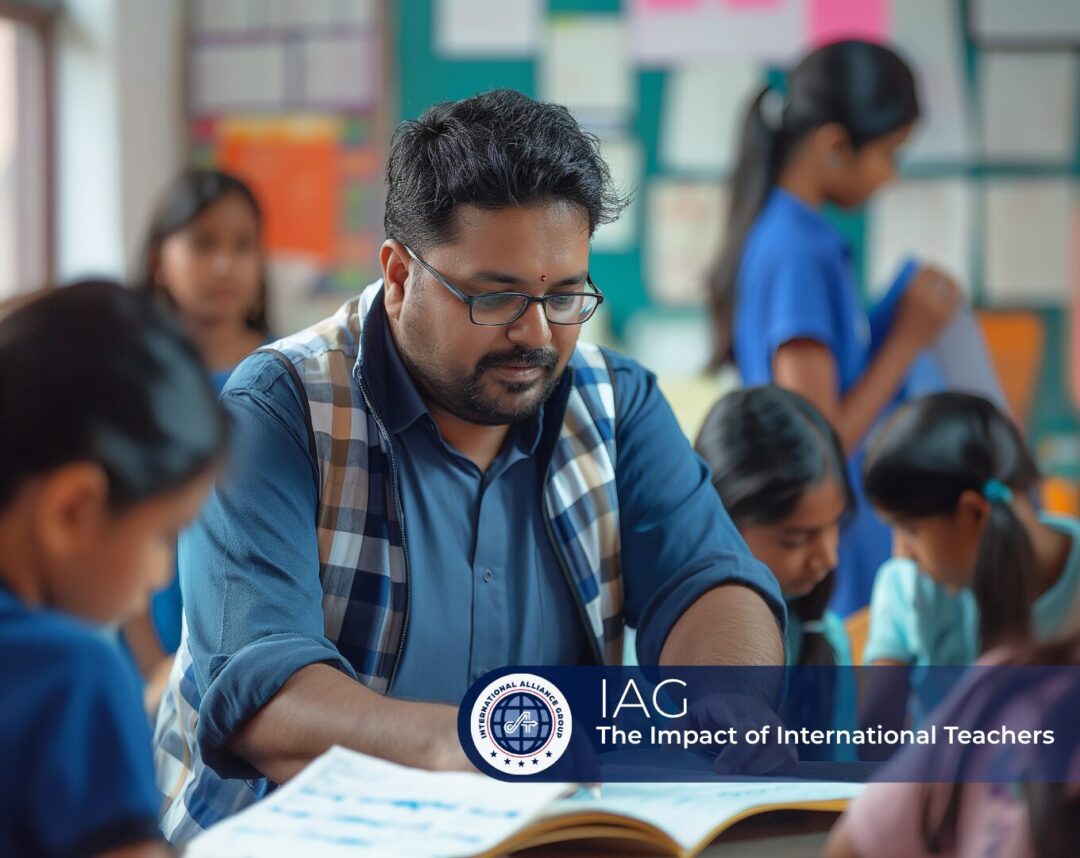
When a teacher who grew up in Manila, Nairobi, or Guadalajara walks into an American classroom for the first time, something happens in that room that cannot be replicated by any curriculum update, technology tool, or professional development program. Something shifts — in the students, in the dynamic, and in the culture of the school itself.
What exactly changes? More than most people expect.
They Start Asking Bigger Questions
Something shifts in a classroom when an international teacher arrives — and one of the first places it shows up is in the questions students ask. Not just about the lesson. About everything: “How do kids my age live in your country?” , “What is the biggest celebration of the year in your country?” , “What do kids eat for breakfast in your country?”
These are not distractions from learning. They are learning — the kind that cannot be found in a textbook and cannot be tested on a standardized exam, but that shapes the kind of thinker a child becomes for the rest of their life.
When a student realizes that the person standing at the front of their classroom grew up in a completely different reality — speaking a different language, eating different food, navigating a different culture — their understanding of the world expands in a way that stays with them. They begin to see their own life as one of many possible lives, rather than the only one.
That shift in perspective is the foundation of critical thinking, empathy, and global awareness. And it happens naturally, organically, simply because a different kind of teacher walked through the door.
They See Excellence From Unexpected Places
Representation matters in education — and not only in the ways that are most commonly discussed.
When students encounter a teacher who is brilliant, passionate, and deeply skilled, and that teacher comes from a country they have never thought much about, something important is recalibrated in their understanding of the world.
Excellence, they learn, does not belong to any one country, language, or background. It comes from everywhere. It looks like everyone.
For students and communities, seeing a teacher who shares their heritage or speaks their home language is a moment of profound recognition. It tells them, without a single word being spoken, that someone who looks like them, sounds like them, or comes from where they come from can stand at the front of a classroom and be extraordinary.
For students who have never encountered that kind of diversity before, it teaches something equally valuable: that the world is full of people worth learning from, and that wisdom does not have a single face.
They Develop Skills That Last a Lifetime
The presence of an international teacher in a classroom trains students in the art of human connection across difference.
They learn to listen carefully to someone whose accent is different from their own. They learn to ask clarifying questions with curiosity rather than impatience. They learn to find common ground with someone whose background is genuinely unlike theirs — and to enjoy the discovery of what they share.
These are not soft skills. They are survival skills for a globalized world — and the students who develop them early carry a significant advantage into every professional and personal relationship they will ever have.
Research consistently shows that students who are exposed to diverse perspectives and cultural backgrounds in their formative years demonstrate stronger social-emotional development, greater adaptability, and more sophisticated communication abilities. They are better prepared for college, for the workforce, and for life in communities that are growing more diverse every year.
A New Lens on Familiar Subjects
The benefits of cultural exchange in the classroom are not limited to social and emotional growth. Academic outcomes improve too — and the mechanisms behind this are well understood.
When students are engaged, they learn more. When they feel that their classroom is a dynamic, interesting place where unexpected things happen, they show up differently — more present, more curious, more willing to take intellectual risks.
International educators bring fresh approaches to content that students have sometimes stopped paying attention to precisely because the presentation has become too familiar. A math lesson framed around a tradition from another country. A science concept illustrated through a cultural practice that has existed for centuries. A history discussion that suddenly includes a perspective the textbook never mentioned.
These moments of surprise and novelty are neurologically significant. They signal to the brain that something worth paying attention to is happening — and that signal translates directly into deeper learning and better retention.
The World Is Bigger Than Their Classroom
Perhaps the most lasting impact of having an international educator is the simplest one to describe and the hardest one to measure.
Students who spend a school year with a teacher from another part of the world finish that year knowing, in a deeply personal way, that the world is larger, more varied, and more interesting than they previously understood.
They know this not because they read it in a book or watched a documentary. They know it because they experienced it — through conversations, through lessons, through cultural references that became familiar over months of shared time, through the simple human reality of knowing someone whose life unfolded somewhere completely different.
That knowledge does not expire. It travels with them into every classroom, every community, and every relationship that follows.
One Teacher. One Classroom. One Community Changed.
The impact of a single international educator ripples outward in ways that are difficult to predict and impossible to contain. It reaches the students in the classroom, the families at home, the colleagues in the building, and the community beyond the school walls.
That is what cultural exchange does. It does not just change a lesson — it changes the people in the room.
At IAG, we connect passionate international educators with school communities across the United States through the J-1 Cultural Exchange Program. If your district is ready to experience that ripple effect firsthand, we would love to connect. Learn how your district can partner with IAG